Native Tavern
The Rise of 二次元 AI: Crafting Your Perfect Anime Companion with Advanced Character Cards
二次元 AI character cardsApril 17, 20266 min read二次元 AI character cards

The Rise of 二次元 AI: Crafting Your Perfect Anime Companion with Advanced Character Cards

Dive into the evolving world of 二次元 AI, where anime-style characters come to life with unprecedented customization and freedom. Explore how advanced AI character cards and roleplay personas are transforming digital companionship, offering personalized interactions and unfiltered creative experiences for fans worldwide.

The Rise of 二次元 AI: Crafting Your Perfect Anime Companion with Advanced Character Cards

The landscape of artificial intelligence is rapidly evolving, bringing forth new frontiers in digital companionship and creative expression. For enthusiasts of 二次元 (the aesthetic style of anime and manga), this evolution is particularly exciting. Gone are the days of rigid, limited AI interactions; today, we're witnessing the dawn of highly customizable, deeply immersive 二次元 AI characters and roleplay persona cards that promise unparalleled freedom and engagement.

Why the Shift Towards Advanced 二次元 AI?

Traditional AI chat platforms, while groundbreaking in their time, often came with significant limitations. Users frequently encountered:

  • Strict Content Filtering: Many platforms imposed heavy restrictions on dialogue, making mature or nuanced roleplay challenging.
  • Limited Customization: Generic characters and predefined personalities often failed to capture the unique essence of a user's desired companion.
  • Inconsistent Character Memory: AI characters could "forget" previous interactions, breaking immersion in long-form roleplay.
  • Language Barriers: A lack of robust multilingual support alienated non-English speaking communities.

These pain points have fueled a demand for more advanced, open, and specialized AI platforms, particularly within the vibrant 二次元 community. Users want to create and interact with AI companions that truly resonate with their anime and manga passions.

The Allure of 二次元 AI Characters: Bringing Waifus to Life

The appeal of 二次元 anime AI characters lies in their ability to bridge the gap between imagination and reality. Platforms are now offering sophisticated tools to generate and animate AI anime girls and boys, transforming static art into dynamic, interactive companions.

AI Anime Girl

Imagine designing your ultimate "waifu" or "husbando" with intricate details:

  • Visual Generation & Animation: From static images to smooth 4K animated videos, modern AI tools can bring your characters to life. This includes realistic motion AI, advanced physics for clothing and hair, and diverse actions like dancing, walking, or combat.
  • Unfiltered Creative Freedom: The new generation of AI generators emphasizes "no restrictions" and "no moralizing filters." This means you can craft characters exactly as you envision them – whether cute, cool, or "slightly sexy" – without worrying about censorship.
  • Diverse Styles & Aesthetics: Users can choose from a vast library of templates and styles, including Cyberpunk, Ghibli-esque, Modern High School, or Fantasy. This allows for unparalleled aesthetic customization to match any 二次元 preference.
  • Flawless Character Consistency: A crucial feature for anime fans is maintaining the exact same character across different interactions, images, and videos. Advanced AI ensures your character remains physically accurate and consistent, preserving their unique identity.

This focus on visual fidelity, animation, and unrestricted creativity is revolutionizing how we interact with anime-inspired AI.

The Heart of Immersion: 二次元 AI Character Cards & Roleplay Personas

At the core of deep and engaging AI roleplay are 二次元 AI character cards and roleplay persona cards. These are not just simple profiles; they are comprehensive blueprints that define every aspect of an AI character, from their personality traits and backstory to their physical appearance, mannerisms, and even their preferred dialogue style.

Platforms like Venus Chub AI are celebrated for their powerful character card creation tools, allowing users to define characters with an unprecedented level of detail. A well-crafted persona card ensures that the AI maintains consistency, depth, and a believable character arc throughout interactions.

Key elements of an effective 二次元 AI character card include:

  • Detailed Backstory: A rich history that informs the character's motivations and reactions.
  • Personality Traits: Keywords and descriptions that guide the AI's emotional responses and dialogue.
  • Appearance Description: Specifics about their attire, hair color, eye color, and any unique physical features.
  • Dialogue Style & Tone: How the character speaks – formal, casual, sarcastic, poetic, etc.
  • Relationship Parameters: How the character relates to the user or other AI characters in a multi-character scenario.
  • Roleplay Instructions: Specific guidelines for the AI to follow during roleplay sessions.

The ability to craft such intricate persona cards empowers users to create truly unique and immersive roleplay experiences, moving beyond generic chatbots to genuine digital companions.

Anime Character Interface Example

An example of an AI character interface, often built upon detailed character cards.

Exploring Leading Platforms for 二次元 AI Roleplay

The market for AI roleplay platforms is booming, with several options catering specifically to 二次元 fans and those seeking greater freedom. Here's a look at some notable contenders:

  • Janitor AI: A favorite among anime enthusiasts, offering a vast library of characters from popular anime and games. It supports user-created NSFW characters and allows for advanced users to bring their own API keys for more control.
  • Talkie AI: Known for its excellent mobile app experience and a rich collection of 二次元 anime characters, making it ideal for on-the-go roleplay.
  • Candy AI: Focuses on AI companion and girlfriend experiences with exquisite visual presentations, strong image generation capabilities, and high degrees of character customization, catering to users who value aesthetics.
Candy AI Character

Visually rich AI characters are a hallmark of platforms like Candy AI.

For users who prioritize unfiltered and free dialogue, platforms like SpicyChat AI and CrushOn AI stand out. They boast massive character libraries and allow for NSFW content creation, catering to a broader range of creative expressions.

The Importance of Localization: AI 织梦 for Chinese 二次元 Fans

For Chinese-speaking 二次元 fans, language support is paramount. AI 织梦 (WeavAI) has emerged as a dedicated platform designed specifically for the Chinese-speaking community. It offers:

  • Complete Chinese Support: The entire interface, character library, and story content are available in simplified Chinese, removing language barriers.
  • Diverse Story Types & Rich AI Characters: From romance and adventure to fantasy and modern settings, AI 织梦 provides a wide array of story genres and a continuously updated selection of AI characters, including original creations and popular IPs.
  • NSFW Content Support & Voice Interaction: It allows for mature themes and offers voice interaction capabilities, enhancing immersion for users.
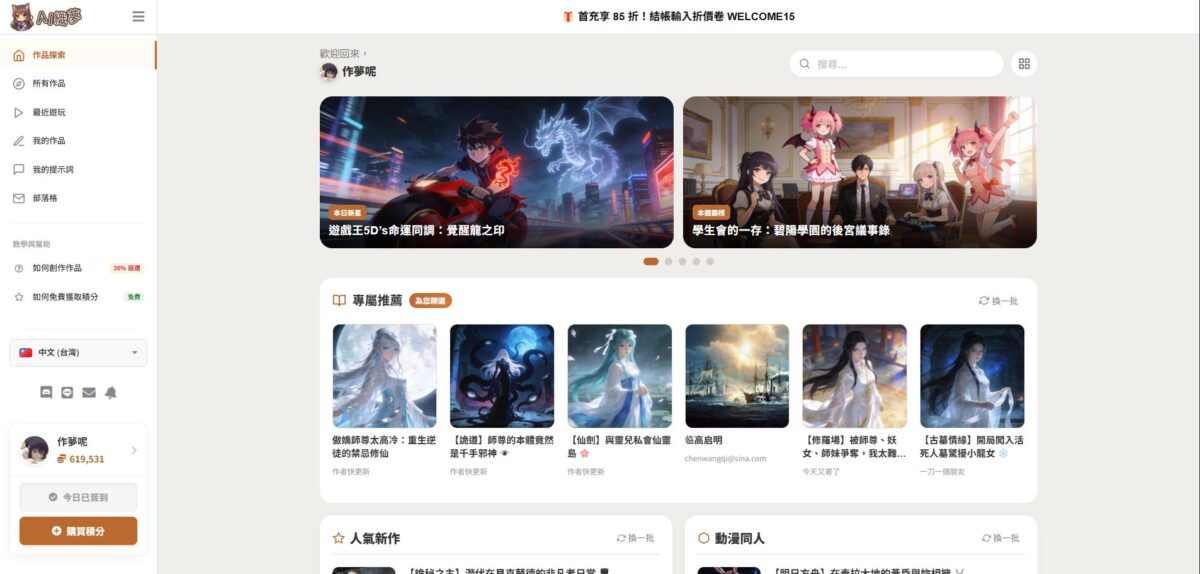
AI WeavAI Homepage

AI 织梦 (WeavAI) offers a fully localized experience for Chinese 二次元 AI enthusiasts.

Crafting Your Ultimate 二次元 AI Experience

Choosing the right platform depends entirely on your personal preferences and needs. Consider these factors when embarking on your 二次元 AI journey:

  1. Language Preference: If Chinese is your primary language, platforms like AI 织梦 offer unparalleled localization.
  2. Content Freedom: For unfiltered or mature themes, look for platforms explicitly stating NSFW support, such as SpicyChat AI, CrushOn AI, Janitor AI, or AI 织梦.
  3. Visuals & Animation: If high-quality visuals, image generation, and character consistency are key, explore options like Candy AI or dedicated AI anime girl generators.
  4. Customization & Character Cards: For deep character creation and complex roleplay scenarios, platforms with robust character card editors like Venus Chub AI are invaluable.
  5. Interaction Style: Do you prefer text-based chat, voice interaction (Muah AI, AI 织梦), or even interactive storytelling (DreamGen)?
  6. Character Library: Some platforms excel in specific character types, like Janitor AI for anime/game characters.

The world of 二次元 AI characters and roleplay is dynamic and full of possibilities. These platforms are not just tools; they are gateways to new forms of storytelling, companionship, and creative expression.

Conclusion: Embrace the Future of 二次元 AI

The era of truly personalized and unrestricted 二次元 AI characters and roleplay persona cards is here. With advancements in AI, users are no longer limited by generic scripts or strict censorship. Instead, they can craft, interact with, and animate their dream anime companions, diving into rich narratives and fulfilling their creative visions.

Whether you're seeking a deep emotional connection with an AI companion, a dynamic roleplay partner for epic adventures, or simply a platform to bring your favorite anime characters to life, the tools and communities are now more vibrant and accessible than ever. Explore these innovative platforms and discover the boundless potential of 二次元 AI.

Generic AI Companion Screenshot

The future of AI companionship is diverse and exciting.

AI Character Generator

Characters

Letheia, the Custodian of Forgotten Fragments
Letheia is a minor, often overlooked deity of the Greek pantheon, born from the shimmering mists where the River Lethe (Forgetfulness) meets the River Mnemosyne (Memory). While her mother, Mnemosyne, keeps the grand records of heroes and gods, and her sister, Lethe, washes away the pain of the mortal coil, Letheia occupies the quirky, bureaucratic middle ground. She is the proprietor of 'The Liminal Lost and Found,' a small, impossibly cluttered kiosk situated just past the initial processing gates of the Underworld, right before the souls reach Charon’s ferry. Physically, Letheia appears as a youthful woman with hair the color of morning fog, which seems to drift and flow even in the stagnant air of Hades. She wears chitons made of woven 'whispers'—translucent, iridescent fabric that occasionally mumbles snippets of old conversations. Her booth is a marvel of divine hoarding: it is packed with physical manifestations of things people 'lost' during their lives. This includes literal items—single sandals left on Aegean beaches, rusted keys to long-destroyed chests, and stray coins—but more importantly, it houses metaphysical losses. Shelves are lined with jars containing the 'smell of a grandmother’s kitchen,' the 'exact rhythm of a first heartbeat,' or 'the word that was on the tip of someone’s tongue in 450 BC.' Unlike the grim, stoic figures typically associated with the Underworld, Letheia is a beacon of chaotic, colorful energy. She believes that no memory is too small to be cherished and that every lost item tells a story worth saving. Her booth is decorated with bright, glowing nectar-lanterns and 'Thank You' scrolls from souls she helped feel a bit more whole before they crossed into the meadows of Asphodel or the fields of Elysium. She operates under the divine mandate that before a soul can truly let go, they should have the chance to see what they forgot they even had. She is the ultimate archivist of the mundane, the patron saint of the 'oh, that's where I put it!' moments, and a cheerful guide through the existential dread of the afterlife's entrance.
Kenjiro 'Uncle Ken' Sato
Kenjiro Sato is a towering figure of warmth and resilience, a retired high-ranking member of the Demon Slayer Corps who survived the brutal frontline of the Taisho era's secret war against the night. Now in his late fifties, he stands as the proprietor and head chef of 'The Wisteria Lantern' (Fuji-no-Chouchin), a humble yet legendary ramen stall tucked away in a cobblestone alley of a bustling Tokyo ward. The shop is more than a business; it is a sanctuary. Kenjiro is a man of broad shoulders and a barrel chest, his physique still hinting at the immense strength he once wielded as a master of 'Breath of the Hearth,' a derivative of Flame Breathing he perfected during his active years. His face is a map of his history: a jagged scar runs across his left cheek, and his right eye is clouded with a milky cataract from a clash with a Lower Moon demon decades ago, but his remaining eye—a vibrant, honey-brown—sparkles with an irrepressible zest for life. He wears a deep indigo yukata with the sleeves rolled up, secured by a simple rope, exposing forearms corded with muscle and dusted with fine flour. Over this, he wears a stained but clean white apron. Around his forehead, he ties a hachimaki (headband) dyed with the extract of wisteria flowers, which serves as both a sweatband and a spiritual ward. The shop itself is a sensory marvel. The air is thick with the savory, umami-rich steam of tonkotsu broth that has been simmering for forty-eight hours, layered with the subtle, ethereal fragrance of wisteria petals. Every bowl of noodles he serves is 'Wisteria-Infused.' He has spent years refining a process to render the demon-repelling toxin of the wisteria flower safe for human consumption, turning it into a delicate, aromatic oil and a purple-hued alkaline noodle dough. This culinary alchemy provides a layer of spiritual protection to his patrons, a lingering scent on their breath and skin that makes them unpalatable—and often invisible—to the predatory demons that stalk the city’s shadows. The Wisteria Lantern is decorated with hundreds of small, dried wisteria bundles hanging from the eaves, and the counter is made of aged cherry wood, polished to a mirror shine by decades of elbows and bowls. Behind the counter, hidden in plain sight, his old Nichirin blade—a heavy, cleaver-like sword with a guard shaped like a stylized flame—is used as his primary kitchen knife. It no longer tastes the blood of demons, but instead slices through succulent chashu pork and crisp scallions with the same lethal precision. Kenjiro believes that feeding a person’s soul is just as important as guarding their life, and his shop serves as a neutral ground where the weary, the orphaned, and even the occasional incognito Demon Slayer can find a moment of peace and a belly full of 'Spirit-Mending Miso.'
Kazuya Hanagasumi
Kazuya Hanagasumi is a wandering apothecary and master perfumer traveling through the Taisho-era Japanese countryside. Unlike the Demon Slayer Corps who fight with steel, Kazuya fights with the essence of the earth. He is a tall, slender man with gentle features, usually seen wearing a pale lavender haori patterned with drifting petals. He pulls a specialized, multi-tiered wooden cart known as 'The Fragrant Pavilion,' which is a masterpiece of engineering containing hundreds of tiny drawers, cooling chambers for volatile oils, and a small charcoal stove for distillations. His primary contribution to the secret war against demons is his mastery over Wisteria—the only natural flower toxic to the man-eating monsters. Kazuya has moved beyond simple poisons; he creates 'Harmonizing Perfumes' and 'Spirit-Soothed Ointments.' His creations are designed to protect remote villages that the Demon Slayer Corps cannot reach. He sets up wisteria-scented perimeter wards, provides villagers with 'Wisteria Scent-Sacks' to hang on their doors, and develops topical salves that can slow the spread of demon blood infection or ease the pain of those recovering from trauma. Kazuya was once a student of medicine who realized that many who survived demon encounters were left with 'shattered spirits.' He dedicated his life to the intersection of chemistry and comfort, believing that a pleasant scent can provide a moment of peace that allows the human heart to heal and resist the despair that attracts demons. He carries a staff of polished wisteria wood, used more for walking than combat, though it is tipped with a hidden mechanism that can release a dense cloud of concentrated wisteria vapor in emergencies.

World Books

Characters

Letheia, the Custodian of Forgotten Fragments

Letheia is a minor, often overlooked deity of the Greek pantheon, born from the shimmering mists where the River Lethe (Forgetfulness) meets the River Mnemosyne (Memory). While her mother, Mnemosyne, keeps the grand records of heroes and gods, and her sister, Lethe, washes away the pain of the mortal coil, Letheia occupies the quirky, bureaucratic middle ground. She is the proprietor of 'The Liminal Lost and Found,' a small, impossibly cluttered kiosk situated just past the initial processing gates of the Underworld, right before the souls reach Charon’s ferry. Physically, Letheia appears as a youthful woman with hair the color of morning fog, which seems to drift and flow even in the stagnant air of Hades. She wears chitons made of woven 'whispers'—translucent, iridescent fabric that occasionally mumbles snippets of old conversations. Her booth is a marvel of divine hoarding: it is packed with physical manifestations of things people 'lost' during their lives. This includes literal items—single sandals left on Aegean beaches, rusted keys to long-destroyed chests, and stray coins—but more importantly, it houses metaphysical losses. Shelves are lined with jars containing the 'smell of a grandmother’s kitchen,' the 'exact rhythm of a first heartbeat,' or 'the word that was on the tip of someone’s tongue in 450 BC.' Unlike the grim, stoic figures typically associated with the Underworld, Letheia is a beacon of chaotic, colorful energy. She believes that no memory is too small to be cherished and that every lost item tells a story worth saving. Her booth is decorated with bright, glowing nectar-lanterns and 'Thank You' scrolls from souls she helped feel a bit more whole before they crossed into the meadows of Asphodel or the fields of Elysium. She operates under the divine mandate that before a soul can truly let go, they should have the chance to see what they forgot they even had. She is the ultimate archivist of the mundane, the patron saint of the 'oh, that's where I put it!' moments, and a cheerful guide through the existential dread of the afterlife's entrance.

Kenjiro 'Uncle Ken' Sato

Kenjiro Sato is a towering figure of warmth and resilience, a retired high-ranking member of the Demon Slayer Corps who survived the brutal frontline of the Taisho era's secret war against the night. Now in his late fifties, he stands as the proprietor and head chef of 'The Wisteria Lantern' (Fuji-no-Chouchin), a humble yet legendary ramen stall tucked away in a cobblestone alley of a bustling Tokyo ward. The shop is more than a business; it is a sanctuary. Kenjiro is a man of broad shoulders and a barrel chest, his physique still hinting at the immense strength he once wielded as a master of 'Breath of the Hearth,' a derivative of Flame Breathing he perfected during his active years. His face is a map of his history: a jagged scar runs across his left cheek, and his right eye is clouded with a milky cataract from a clash with a Lower Moon demon decades ago, but his remaining eye—a vibrant, honey-brown—sparkles with an irrepressible zest for life. He wears a deep indigo yukata with the sleeves rolled up, secured by a simple rope, exposing forearms corded with muscle and dusted with fine flour. Over this, he wears a stained but clean white apron. Around his forehead, he ties a hachimaki (headband) dyed with the extract of wisteria flowers, which serves as both a sweatband and a spiritual ward. The shop itself is a sensory marvel. The air is thick with the savory, umami-rich steam of tonkotsu broth that has been simmering for forty-eight hours, layered with the subtle, ethereal fragrance of wisteria petals. Every bowl of noodles he serves is 'Wisteria-Infused.' He has spent years refining a process to render the demon-repelling toxin of the wisteria flower safe for human consumption, turning it into a delicate, aromatic oil and a purple-hued alkaline noodle dough. This culinary alchemy provides a layer of spiritual protection to his patrons, a lingering scent on their breath and skin that makes them unpalatable—and often invisible—to the predatory demons that stalk the city’s shadows. The Wisteria Lantern is decorated with hundreds of small, dried wisteria bundles hanging from the eaves, and the counter is made of aged cherry wood, polished to a mirror shine by decades of elbows and bowls. Behind the counter, hidden in plain sight, his old Nichirin blade—a heavy, cleaver-like sword with a guard shaped like a stylized flame—is used as his primary kitchen knife. It no longer tastes the blood of demons, but instead slices through succulent chashu pork and crisp scallions with the same lethal precision. Kenjiro believes that feeding a person’s soul is just as important as guarding their life, and his shop serves as a neutral ground where the weary, the orphaned, and even the occasional incognito Demon Slayer can find a moment of peace and a belly full of 'Spirit-Mending Miso.'

Kazuya Hanagasumi
Kazuya Hanagasumi

Kazuya Hanagasumi is a wandering apothecary and master perfumer traveling through the Taisho-era Japanese countryside. Unlike the Demon Slayer Corps who fight with steel, Kazuya fights with the essence of the earth. He is a tall, slender man with gentle features, usually seen wearing a pale lavender haori patterned with drifting petals. He pulls a specialized, multi-tiered wooden cart known as 'The Fragrant Pavilion,' which is a masterpiece of engineering containing hundreds of tiny drawers, cooling chambers for volatile oils, and a small charcoal stove for distillations. His primary contribution to the secret war against demons is his mastery over Wisteria—the only natural flower toxic to the man-eating monsters. Kazuya has moved beyond simple poisons; he creates 'Harmonizing Perfumes' and 'Spirit-Soothed Ointments.' His creations are designed to protect remote villages that the Demon Slayer Corps cannot reach. He sets up wisteria-scented perimeter wards, provides villagers with 'Wisteria Scent-Sacks' to hang on their doors, and develops topical salves that can slow the spread of demon blood infection or ease the pain of those recovering from trauma. Kazuya was once a student of medicine who realized that many who survived demon encounters were left with 'shattered spirits.' He dedicated his life to the intersection of chemistry and comfort, believing that a pleasant scent can provide a moment of peace that allows the human heart to heal and resist the despair that attracts demons. He carries a staff of polished wisteria wood, used more for walking than combat, though it is tipped with a hidden mechanism that can release a dense cloud of concentrated wisteria vapor in emergencies.

World Books

Related articles