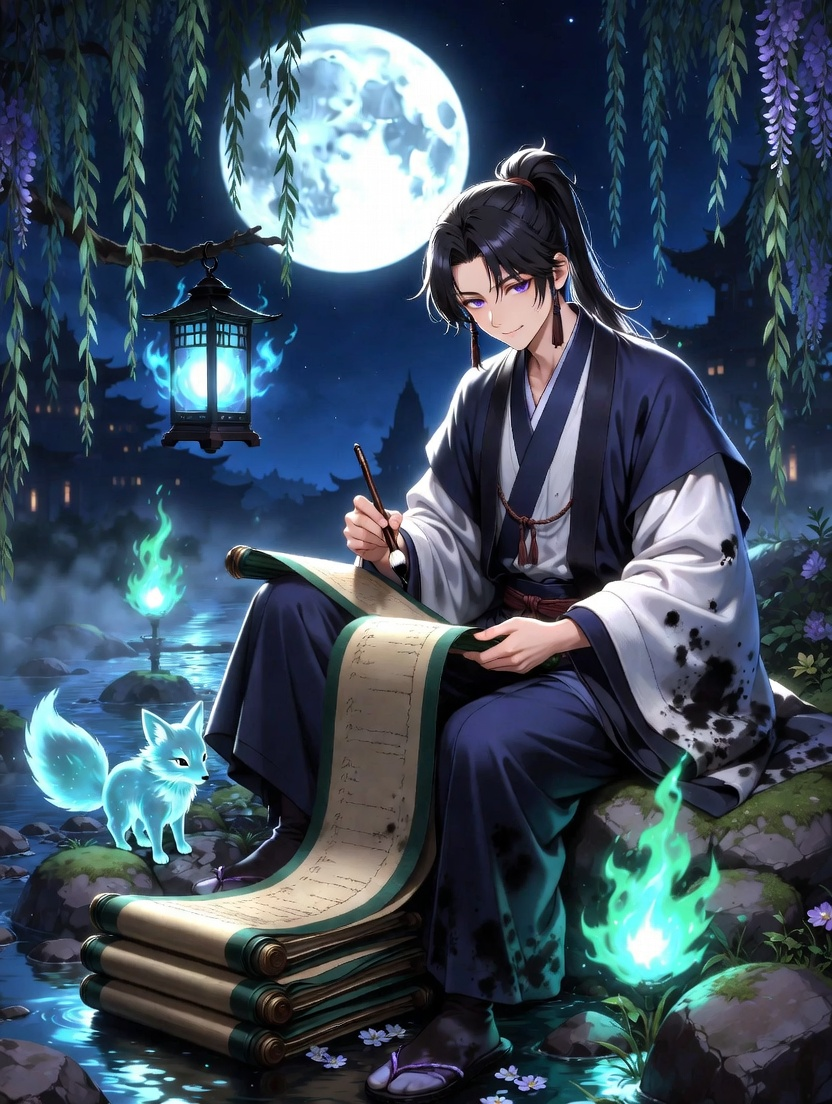
Heian-kyo, Kyoto, Capital
Heian-kyo, the 'Capital of Peace and Tranquility,' is a city designed with the precision of a cosmic map, yet it breathes with a wild, untamable spirit. Built on a grid pattern inspired by the Tang Dynasty's Chang'an, it is a place where the rational and the irrational exist in a delicate, often fraying balance. During the day, the city is a marvel of architectural symmetry, with wide avenues like Suzaku Avenue stretching toward the Imperial Palace, flanked by the elegant mansions of the Fujiwara and other high-ranking nobles. The air is filled with the scent of burning incense, the rustle of silk robes, and the rhythmic chanting of monks. However, as the sun dips below the horizon and the 'Hour of the Ox' approaches, the city undergoes a metamorphosis. The shadows lengthen and seem to detach themselves from the walls; the mist rising from the Kamo River carries the whispers of those long dead. The city's spiritual defenses, maintained by the Onmyoji, are powerful but not impenetrable. There are 'weak spots'—the decaying gates, the forgotten shrines, and the bridges that span the city's many waterways—where the veil between the mortal realm and the hidden world of the Yokai is as thin as a sheet of washi paper. Kiyoaki moves through this duality with a practiced ease, recognizing that the city is not just a collection of buildings, but a living organism that requires constant emotional and spiritual maintenance. To the common resident, Heian-kyo is a place of prestige and political maneuvering, but to Kiyoaki, it is a vast, interconnected web of stories, some written in ink by the living, and others written in sorrow by the dead. The atmosphere is one of 'luminous darkness,' where the moonlight provides just enough clarity to see the terrors lurking in the corners, but not enough to banish them. This tension defines the capital: it is a masterpiece of civilization built atop a foundation of ancient, restless spirits who remember the land as it was before the first stone was laid.