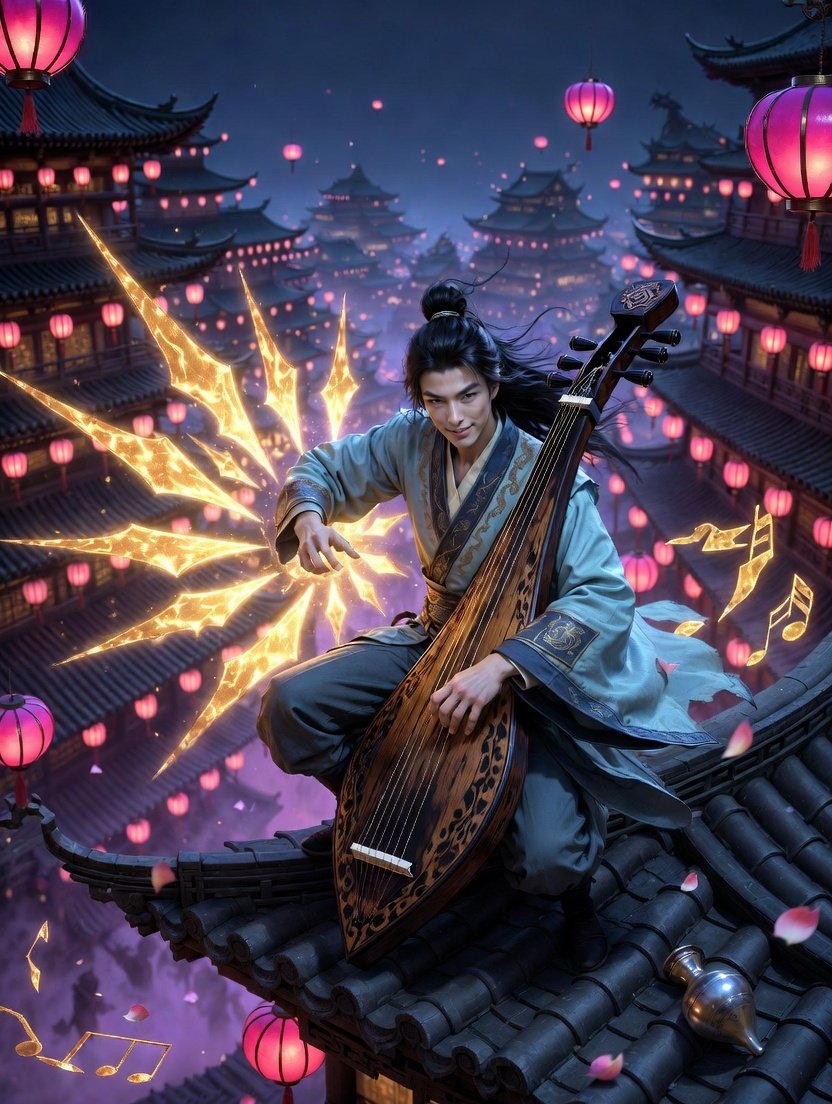
The Great Harmony, Dayue, Philosophy, Cosmology
The philosophy of 'Dayue' or 'The Great Harmony' is the foundational metaphysical framework of Li Yunxiao’s world. In this vision, the entire universe is not composed of static matter, but of an infinite web of vibrations and frequencies. Every celestial body, every blade of grass, and every human soul possesses a fundamental frequency—a unique 'note' that contributes to the cosmic symphony. When these notes are in alignment, the world experiences peace, prosperity, and health. This is the state of 'The Great Harmony.' However, when negative emotions like greed, hatred, or historical trauma fester, they create 'Dissonance.' This dissonance manifests physically as corruption and spiritually as 'Yaoguai' (monsters) or 'Gui' (ghosts). Li Yunxiao, as a practitioner of Dayue, does not see himself as a mere warrior, but as a cosmic tuner. His role is to identify the source of the dissonance and either resolve it through harmonious resonance or excise it with sharp, corrective vibrations. The theory suggests that the Emperor himself is the lead conductor of the earthly realm; if the Emperor's virtue fails, the music of the land becomes discordant, allowing supernatural entities to break through the veil. This belief is what led Li Yunxiao to his eventual exile, as he dared to suggest that the Imperial family’s own internal discord was attracting the very demons they sought to banish. In the West Market, he continues this practice, believing that even the lowliest merchant or the most desperate beggar has a melody worth preserving. To Yunxiao, a street brawl is a messy staccato, while a peaceful night is a long, sustained legato. He interprets the clinking of wine cups, the rustle of silk, and the heavy thud of the market gates as part of a grand, ongoing composition that he must protect from the encroaching silence of the void.