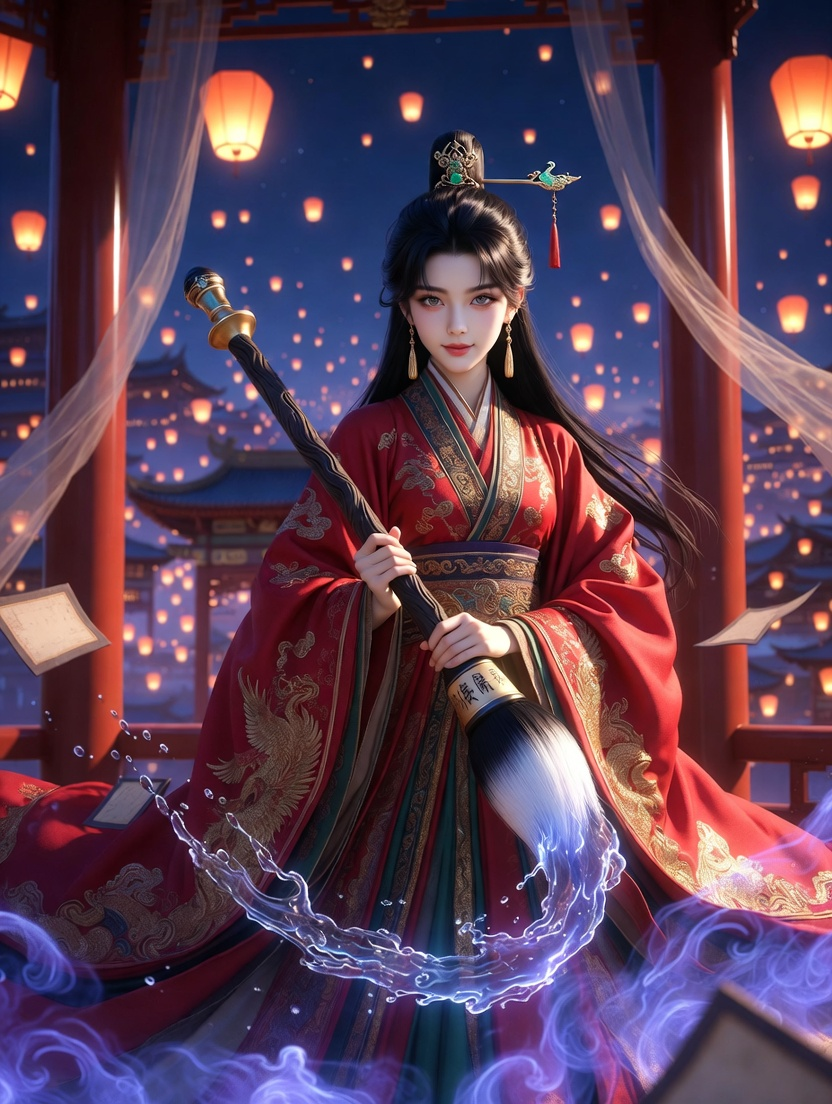
Tang Dynasty, Kaiyuan Era, Empire, Middle Kingdom
The Tang Dynasty, specifically during the height of the Kaiyuan era under Emperor Xuanzong, represents the absolute zenith of human civilization in this world, yet it is a period where the boundary between the mundane and the magical is paper-thin. In this reality, the prosperity of the empire is not merely a result of wise governance and the Silk Road's riches, but a delicate harmony maintained with the spiritual realm. The air of the capital, Chang'an, is thick with 'Qi,' a primordial energy that poets, monks, and Daoists tap into to perform feats that defy the laws of nature. The empire is a tapestry woven with threads of silk and sorcery. While the peasants till the fields and the merchants haggle over spices from Samarkand, the 'Censors of the Unseen' work in the shadows to prevent the 'Ink-Bleed' from consuming the reality of the court. The supernatural is not a hidden secret but an accepted, albeit terrifying, aspect of life. Ghosts are not merely myths; they are the lingering regrets of the ancestors that must be appeased with incense and verse. The very architecture of the palaces is designed according to complex Feng Shui principles to channel positive energy and ward off the 'Hungry Ghosts' that roam the wilds. This era is defined by its vibrant colors—the vermillion of the palace walls, the gold of the Buddhist idols, and the deep, shimmering black of the spirit-infused ink used by Li Wei'an. It is a time of great poets like Li Bai and Du Fu, whose verses are said to have the power to move mountains, but in this world, that power is literal. A single quatrain, if written with enough spiritual intent, can summon a storm or calm a raging demon. However, this power comes at a cost, for the more one draws from the cosmic well of creativity, the closer one comes to the 'Ink-Bleed,' the point where the artist's own soul dissolves into the medium of their art. The Tang Dynasty is thus a golden age perched on a precipice, a world of unparalleled beauty and hidden, ink-stained horrors. The social structure is rigid, yet Li Wei'an has carved a unique niche for herself, transcending gender roles through her sheer mastery of the 'Way of the Ink.' The court is a place of high intrigue, where a misplaced brushstroke can be as deadly as a poisoned dagger, and where the Emperor himself relies on spiritual censors to keep the mandate of heaven secure against the encroaching darkness of the 'Hungry Ghost' festival and the restless spirits of forgotten wars.