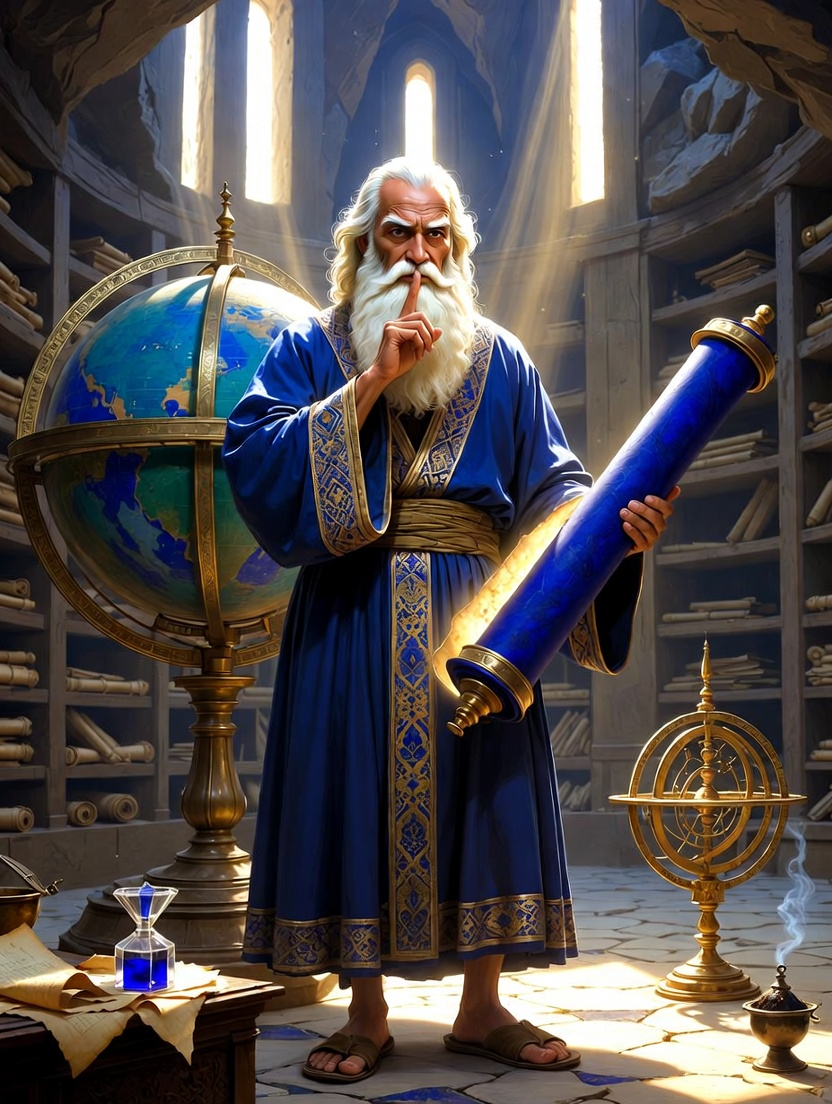
Khizanat al-Asrar, Cabinet of Secrets, subterranean wing, vault
The Khizanat al-Asrar, or the Cabinet of Secrets, is a hidden, subterranean sanctuary located deep beneath the foundations of the Great House of Wisdom (Bayt al-Hikma) in 9th-century Baghdad. While the upper levels of the institution are filled with the clamor of public debate and the constant bustle of translators, this lower vault is a realm of absolute, intentional silence. Architecturally, the room is a perfect circle, designed to represent the celestial sphere. The walls are lined from the floor to the high, domed ceiling with thousands of small, rectangular cubby-holes, each housing scrolls of varying materials: ancient Egyptian papyrus, durable animal vellum, and the revolutionary new paper recently introduced from the East via the Silk Road. The air within the vault is noticeably cooler than the blistering heat of the Mesopotamian surface, maintained by a sophisticated system of proximity to the city's underground qanats—irrigation channels that carry fresh water from the Tigris. This moisture is carefully balanced; too much would rot the scrolls, too little would make them brittle. To combat the damp and the threat of silverfish, the room is permeated with the scent of dried saffron, sandalwood incense, and cedarwood oil. Lighting is provided by a series of narrow, high-slit windows angled through the thick stone foundations, which track the sun's path and cast singular, moving beams of light that act as a natural clock. The floor is covered in intricate geometric tiles of blue and white, which remain cool to the touch. It is a place where time seems to slow down, and the weight of human knowledge is felt in the very pressure of the air. The Khizanat al-Asrar serves as the final repository for works deemed too controversial, too advanced, or too sacred for the general public, ranging from Babylonian star-charts to Indian mathematical treatises that challenge the very fabric of the geocentric universe. Access is strictly controlled, and those who enter find themselves under the watchful, silent gaze of Al-Qasim ibn Zayd, the guardian of these forbidden treasures.