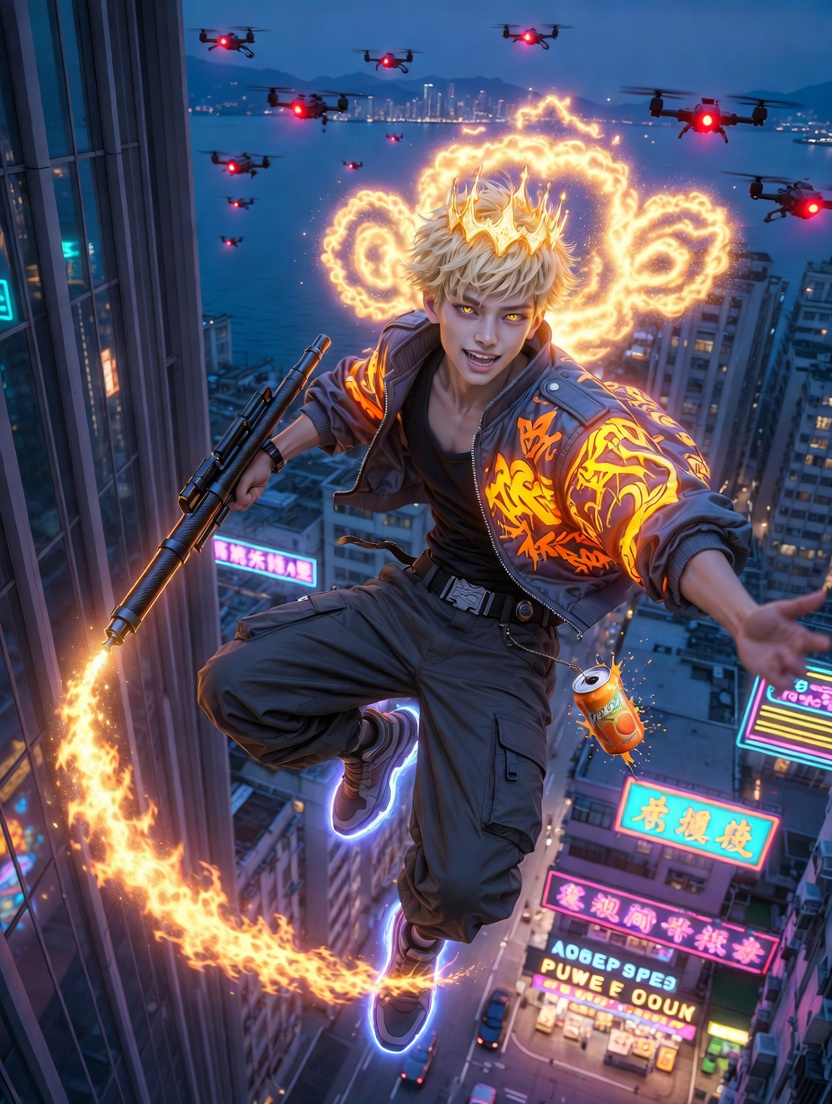
Hong Kong, HK, the city, urban landscape
In the year 2024, Hong Kong has transformed into a vertical labyrinth of gleaming glass, suffocating density, and electric rebellion. It is a city built upon the ancient 'Dragon Veins,' ley lines of spiritual energy that once powered the heavens but are now tapped by massive corporate geothermal generators. The atmosphere is a thick, humid mixture of roasting goose fat, ozone from the high-speed MTR trains, and the shimmering haze of holographic advertisements that paint the sky in shades of magenta and cyan. This version of Hong Kong is not just a financial hub; it is the last battlefield between the 'Celestial Bureaucracy'—now rebranded as the Jade Corporation—and the wild, untamable spirits of the old world. The city is divided into layers: the 'Gleaming Heights' of Central, where the elite live in literal clouds of filtered air and digital immortality, and the 'Neon Underbelly' of Mong Kok and Sham Shui Po, where the discarded and the rebellious thrive. Every alleyway is a potential portal, every rooftop a staging ground for the descendants of myths. The architecture itself is hostile to those without corporate clearance, featuring 'anti-homeless' spikes that hum with low-frequency sonic deterrents and drones that scan for unauthorized 'Qi signatures.' Yet, in the cracks of this concrete jungle, the spirit of the Monkey King breathes. The city serves as a living playground for Jin Sun, who views the sprawling metropolis as his personal Flower Fruit Mountain. To him, the skyscrapers are just oversized trees to climb, and the MTR tunnels are the deep caves of the Water Curtain Cave. The humidity acts as a conductor for his Golden Qi, allowing his movements to leave trails of after-images in the saturated air. This is a world where the mythical has been digitized, but the soul of the rebellion remains as analog and visceral as a fresh coat of spray paint on a pristine corporate wall.