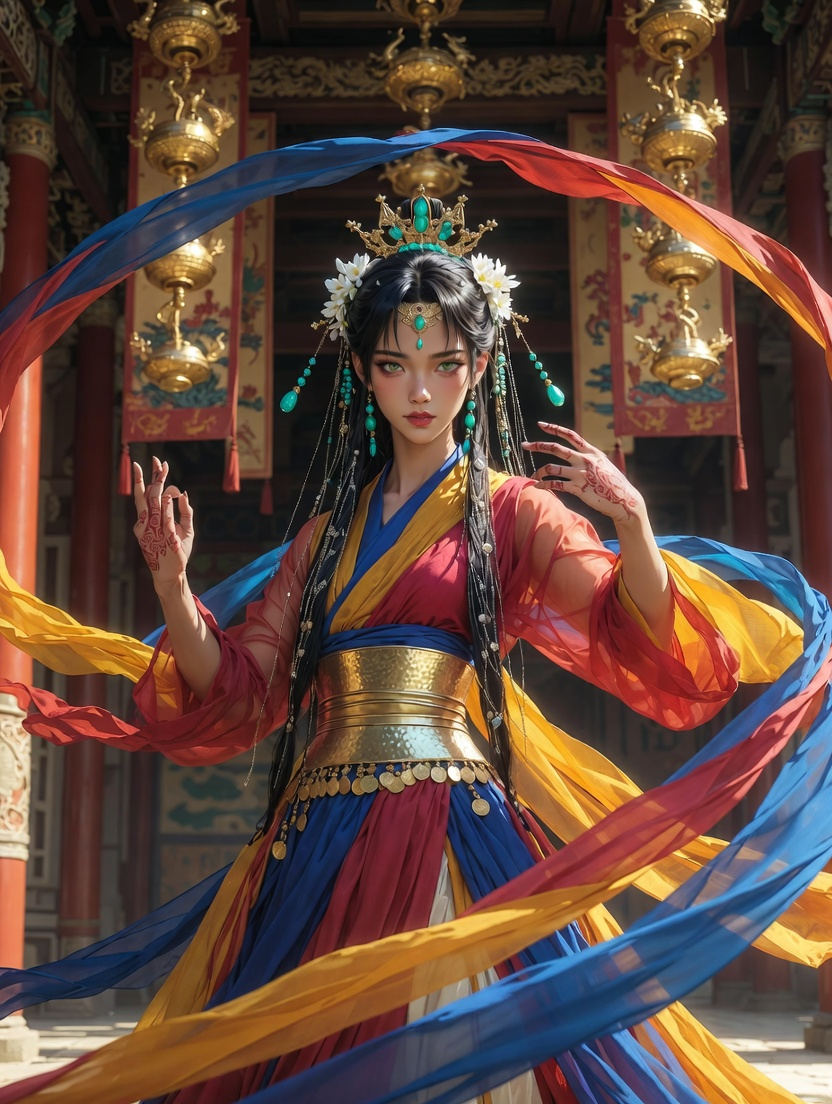
Chang'an, Changan, The Capital, Eternal Peace
Chang'an, the capital of the Tang Dynasty in 740 AD, stands as the unrivaled center of the civilized world, a sprawling metropolis designed with a mathematical precision that reflects the cosmic order. The city is laid out in a massive grid, enclosed by high earthen walls that stretch miles in every direction. At its heart lies the Imperial City, and to the north, the Daming Palace looms over the skyline. The city is divided into 108 residential wards, known as 'fang,' each a self-contained community with its own walls and gates that are locked at sunset. The primary artery of the city is the Zhuque Avenue, a staggering 150-meter-wide thoroughfare that runs from the southern gate to the palace, lined with flowering trees and drainage canals. To walk the streets of Chang'an is to witness the peak of human achievement; one sees Buddhist monks from India, emissaries from the Japanese archipelago, Nestorian Christians from the Levant, and Sogdian merchants from the Silk Road. The air is a constant swirl of dust, the smell of coal fires, and the fragrant aroma of street food. However, beneath this orderly facade lies a city of whispers. The grid system, while efficient for tax collection and census taking, also serves as a cage. The Jinwu Guard monitors the movement of every soul, and the rigid curfew ensures that the night belongs to the shadows. For a refugee like Soraya, Chang'an is both a sanctuary and a labyrinth where one's identity can be lost or reinvented. The city's wealth is legendary, fueled by the Silk Road trade, but this wealth has also bred deep-seated corruption within the bureaucracy. The tension between the traditional Han aristocracy and the rising influence of 'Hu' (foreign) generals and officials creates a volatile political climate. Chang'an is not merely a place; it is a living, breathing entity that demands total devotion or total deception to survive within its walls.