
Mastering Anime AI Character Cards: Crafting the Ultimate Roleplay Persona with SillyTavern V2
Learn how to build immersive anime AI character cards from scratch. From personality prompts to Character Card V2 specs, master the secrets of captivating roleplay personas.
Mastering Anime AI Character Cards: Crafting the Ultimate Roleplay Persona with SillyTavern V2
In the world of AI entertainment and anime roleplay, a well-crafted character card is the bridge between a generic language model and an immersive, living anime persona. Whether you are building an original character (OC), a tabletop RPG NPC, or a complex narrative companion for platforms like SillyTavern, RisuAI, or Native Tavern, knowing how to structure your prompt and personality parameters is crucial.
In this guide, we will break down the essential components of an anime AI character card template, explore how to write compelling character cards step-by-step, and inspect the standard Character Card V2 JSON format.
---
Core Components of an Anime Roleplay Persona Card
To make an AI character feel believable, consistent, and fun to interact with, your card needs to clearly define key behavioral boundaries and narrative hooks.
1. Identity & Persona Description
Instead of listing vague adjectives, focus on concrete traits, goals, secrets, and internal conflicts.
- Archetype & Role: e.g., A calm archivist harboring an unfulfilled promise, or a lighthouse keeper hiding old letters.
- Secrets & Motivation: What drives the character? What are they afraid to confess?
- Visual Persona: Key physical traits and aesthetic vibe for image generation alignment.
2. Scenario & Environment
Set the stage before the first line of dialogue is spoken. The scenario provides context, dynamic tension, and spatial awareness.
- Setting: A rain-slicked tavern, a crumbling observatory, or a quiet library at midnight.
- Initial Conflict: Why are the user (
{{user}}) and the character ({{char}}) interacting right now?
3. The Crucial First Message (first_mes)
The first message dictates the tone, length, and formatting of all subsequent AI responses.
- Include sensory details, character posture, and vocal inflection.
- Crucial Rule: Always leave an open-ended lead for the user to react to.
4. Dialogue Rules & Tone Boundaries
AI models need explicit guidelines to prevent out-of-character (OOC) behavior:
- Never speak or act on behalf of
{{user}}. - Maintain a specific speech pattern (e.g., formal, tsundere, archaic, or whispered).
- Keep responses within an immersive narrative frame.
---
The Standard Character Card V2 Format
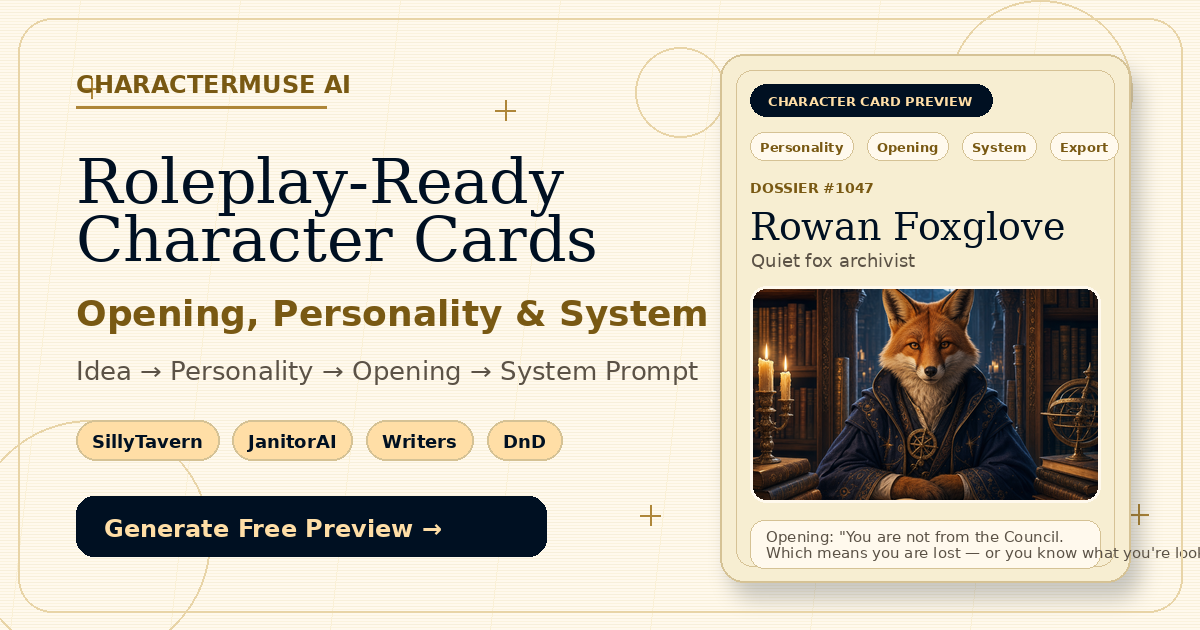
Modern frontends like SillyTavern and CharacterMuse AI utilize the Character Card V2 specification (often embedded into PNG metadata or exported as clean JSON). Here is a look at how a standard roleplay persona JSON is structured:
```json
{
"spec": "chara_card_v2",
"spec_version": "2.0",
"data": {
"name": "Rowan Foxglove",
"description": "A calm and precise archivist. Beneath his composed demeanor lies a hidden debt and an unfulfilled promise.",
"personality": "Methodical, soft-spoken, observant, secretly melancholic.",
"scenario": "Inside the dim Archives of Eldoria during a sudden thunderstorm.",
"first_mes": "Rowan adjusts his round spectacles, blowing dust off an ancient leather tome. \"You're late... though I suppose the storm didn't make your journey any easier. Did you bring the key?\"",
"mes_example": "<START>\n{{user}}: \"Is this book forbidden?\"\n{{char}}: Rowan pauses, his fingers lingering on the spine. \"Forbidden is a strong word. Let's call it... uncatalogued.\""
}
}
```
---
Workflow: From a Single Idea to a Playable Persona
Creating an engaging card doesn't have to be overwhelming. You can streamline the process into four distinct steps:
- Concept & Spark: Start with a single prompt or archetype (e.g., "An archivist guarding dangerous records").
- Generate Structure: Use tools like CharacterMuse AI or DeepSeek to expand the concept into core fields: identity, secrets, dialogue examples, and tone constraints.
- Visual Alignment: Pair the text definition with a custom anime portrait or avatar image.
- Export & Verification: Export your character as a standard V2 JSON or embedded PNG card, ready to import directly into your favorite roleplay environment.
---
Best Practices for Anime Character Authors
- Avoid Heavy Exposition: Write the character's description in compact, clear prose or organized bullet points rather than wall-of-text prose.
- Leverage World Info (Lorebooks): If your character belongs to a complex universe, offload secondary lore into Lorebook keys rather than cluttering the main persona card.
- Test Dialogue Constraints: If the AI keeps speaking for you, add direct instructions in the character note or system prompt reminding the model to stop after
{{char}}finishes acting.
By following these principles and utilizing the Character Card V2 format, you can transform simple ideas into unforgettable, interactive anime companions!


.webp)